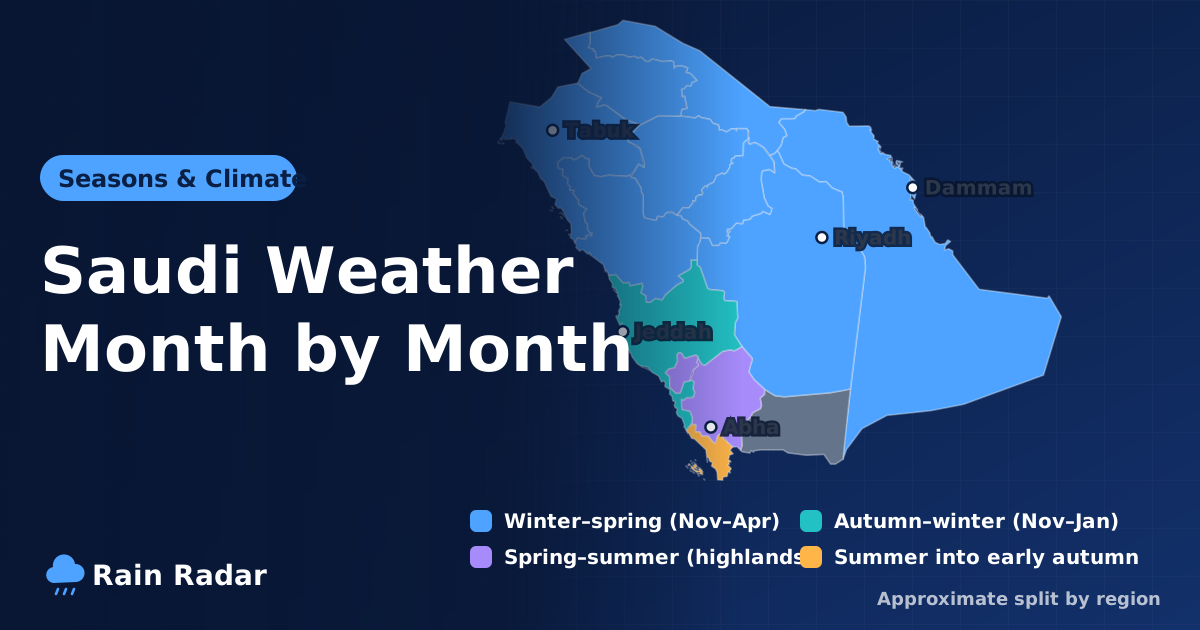
Saudi Arabia's weather changes a lot by month and by region. Winter (December to February) is cold in the north and centre but mild on the coasts; spring (March to April) brings thunderstorms and dust; summer (June to September) is extremely hot inland and humid on the coasts, with summer rain in the southwest; and October and November bring the heat down again. For most travellers, the best time to visit is roughly November to March.
Below is an approximate month-by-month guide, followed by a summary table, to help you plan trips, Umrah, work travel and desert weekends with confidence.
Why does the weather vary so much across Saudi Arabia?
The Kingdom is huge, with inland deserts, coastlines on the Red Sea and the Arabian Gulf, and high mountain ranges in the southwest. On the same winter day it can be cold in Turaif and warm in Jeddah. Broadly, there are four climate types:
- The centre and Qassim (e.g. Riyadh weather, Buraydah): cold winters and very hot, dry summers.
- The west coast (Jeddah, Yanbu, Al-Qunfudhah): warm winters and hot, humid summers.
- The southwestern highlands (Abha, Taif, Al-Baha): relatively mild all year, with summer rain.
- The north (Tabuk, Arar, Turaif, Al-Qurayyat): the coldest part of the Kingdom in winter.
The Eastern Province (Dammam, Al-Ahsa) is similar to the centre for temperature but much more humid because of the Gulf.
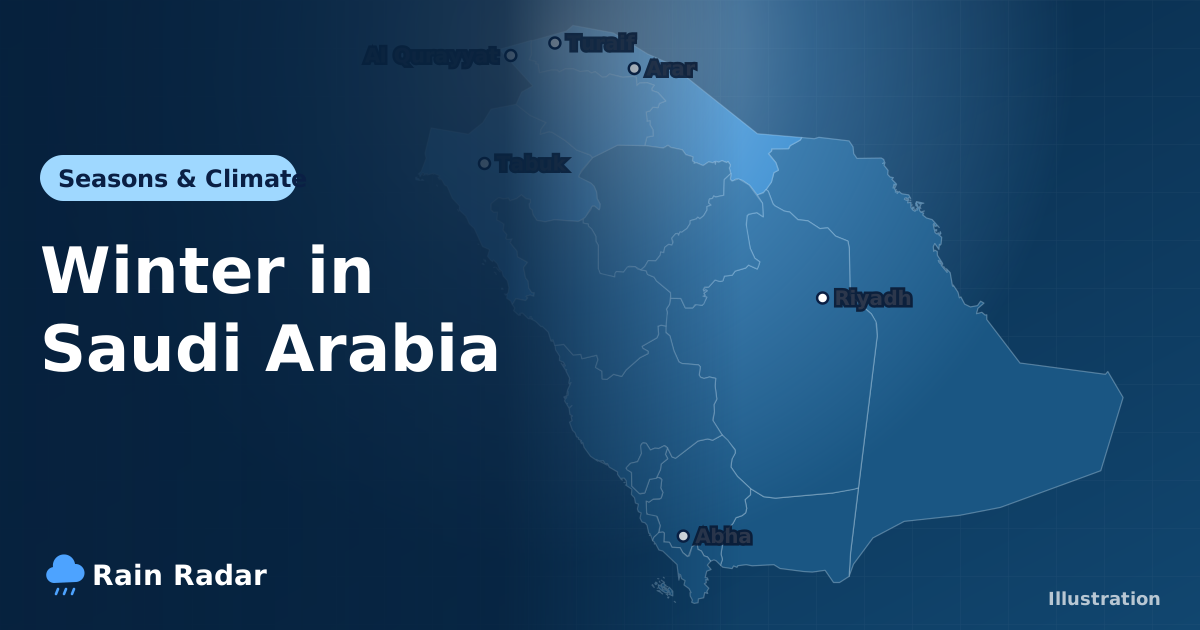
Saudi Arabia weather in winter: December, January, February
December
Winter arrives in December, and early in the month the traditional cold period Al-Murabba'aniyah begins. Nights get noticeably colder in the centre and north, rain becomes more frequent in scattered areas, and the west coast stays mild and comfortable.
January
January is usually the coldest month. Nights can drop below freezing in the north, for example in Turaif and Al-Qurayyat, frost sometimes forms, and snow occasionally falls on high ground around Tabuk. In Riyadh, days are pleasant and nights cold.
February
February starts cold and gradually warms towards the end of the month. Winds pick up at times, with occasional dust, and rain chances continue in the centre, north and east.
Saudi Arabia weather in spring: March, April, May
March
March is one of the most changeable months. Thunderstorms build over the centre, east and north, sometimes with short heavy rain, hail and strong gusts, and dust storms become more likely. Check the live rain radar before a desert trip.
April
Spring continues with a clear rise in temperature. Thunderstorms remain possible, and the southwestern highlands start to get more regular rain. Dust is one of the defining features of April inland.
May
By May the interior enters the hot season, with long, dry days. Rain becomes rare in the centre and east, while afternoon thunderstorms continue in Asir, Jazan and Al-Baha.
Saudi Arabia weather in summer: June to September
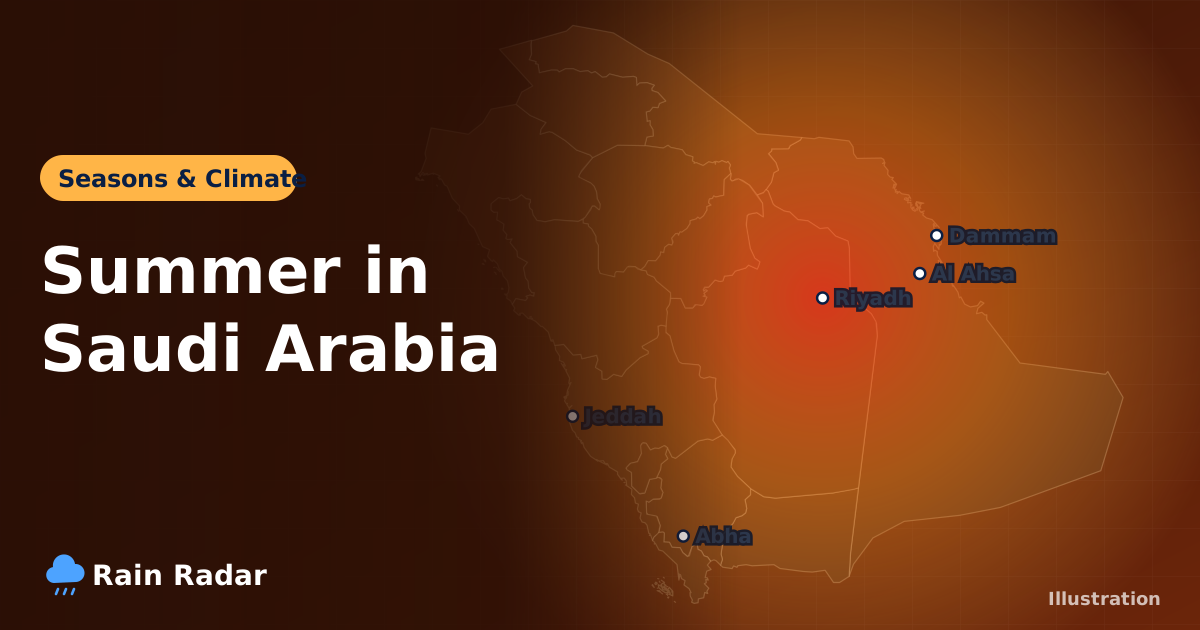
Summer is the longest season. In Riyadh, Dammam and Al-Ahsa, temperatures can pass 45 °C on some days, the sun is fierce and the UV index is high. On both coasts, humidity makes the heat feel even stronger than the temperature suggests.
July and August
These are usually the hottest months, and August is among the most humid on the coasts. Meanwhile, the southwestern highlands get frequent afternoon thunderstorms that can set valleys flowing, which is why many people escape to Abha, Taif and Al-Baha. Check Abha weather now before you travel.
September
September stays hot for most of the month, but by the end nights start to ease in the centre and north. Humidity stays high on the coasts, and some rain continues in the southwest. Read more in our guide to summer in Saudi Arabia.
Saudi Arabia weather in autumn: October and November
October
October is a transition month. The heat steadily falls, and around mid-October the traditional autumn rain season Al-Wasm begins, eagerly awaited in Najd. Nights become pleasant and the first rain clouds may appear.
November
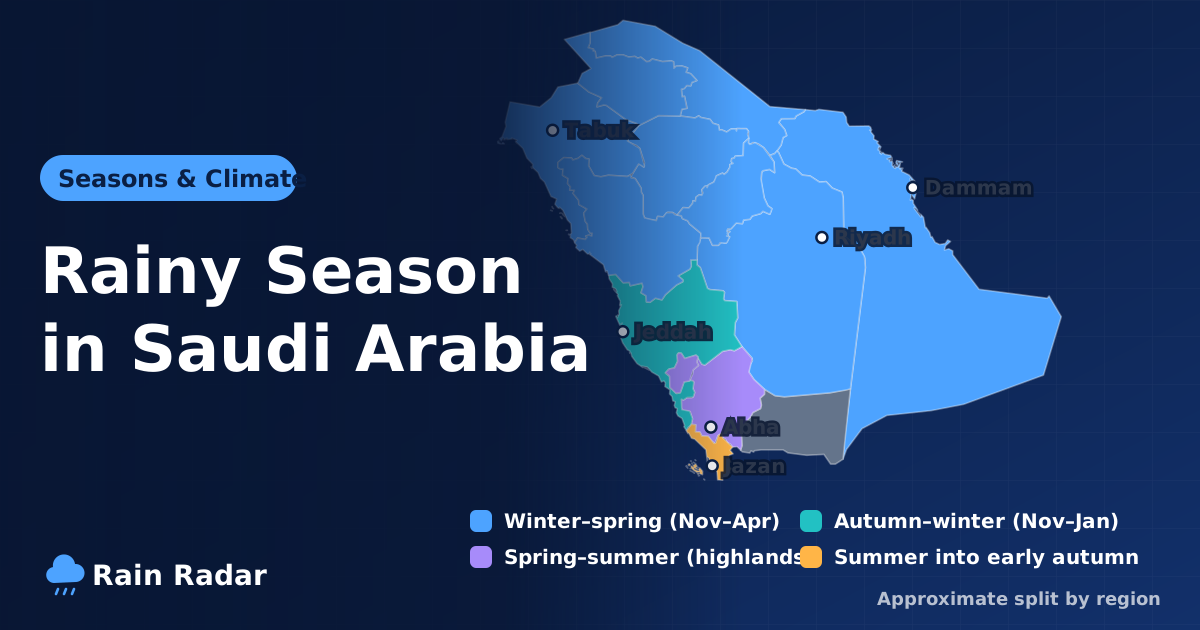
November marks the start of the rainy season on the west coast in Jeddah, Makkah, Rabigh and Al-Qunfudhah. Rain there tends to be short but heavy, which explains the fast street flooding seen in events such as the Jeddah floods of November 2009. Follow Jeddah weather live. In the centre and Qassim, Wasm rain continues and temperatures drop clearly. For city-by-city rain timing, see the rainy season in Saudi Arabia.
Saudi Arabia weather by month: summary table
This table is an approximate overview only; conditions vary from year to year and day to day.
| Month | Centre and east | West coast | Southwest highlands | North |
|---|---|---|---|---|
| January | Cold nights, scattered rain | Mild and pleasant | Fairly cold | Very cold, some frost |
| February | Cool, warming; some dust | Mild | Fairly cold | Cold |
| March | Thunderstorms and dust | Warm | Mild with rain | Mild with rain |
| April | Warm, storms and dust | Warm to hot | Thunderstorms | Mild |
| May | Hot and dry | Hot | Mild, afternoon storms | Warm to hot |
| June | Very hot | Hot and humid | Mild | Hot |
| July | Extremely hot | Very hot and humid | Summer rain | Hot |
| August | Extremely hot | Very hot and humid | Frequent summer rain | Hot |
| September | Hot | Hot and humid | Mild with rain | Hot, easing |
| October | Warm; Al-Wasm begins | Fairly hot | Mild | Mild |
| November | Mild; Wasm rain | Rainy season begins | Mild to cool | Cold nights |
| December | Cold; Murabba'aniyah | Mild with rain | Fairly cold | Very cold |
So when is the best time to visit Saudi Arabia?
- Riyadh, AlUla and the desert: roughly November to March, when days are mild. Pack a warm layer for desert nights. See AlUla weather.
- Jeddah and the Red Sea coast: roughly November to March, when it is warm without the summer humidity.
- Makkah and Madinah: winter is the most comfortable; see our guide to Makkah weather for Umrah.
- Abha, Al-Baha and Taif: summer, when they offer a cool escape from the heat, with afternoon storms.
How to check today's weather in Saudi Arabia
A monthly guide gives you the big picture, but daily decisions need live data. On the home page, the live radar plays the last 2 hours of observed rain in roughly 10-minute frames (RainViewer), and the 7-day forecast maps (NOAA GFS) show what is coming. Each city in all Saudi cities has current conditions and feels-like temperature, an hourly and 7-day forecast (Open-Meteo), UV index, sunrise and sunset, and air quality.
Radar shows rain that has actually been observed, while forecasts come from models that are sometimes wrong. Official warnings come from the National Center for Meteorology and Civil Defense.
Frequently asked questions
What is the best time to visit Saudi Arabia for good weather?
For most of the country, roughly November to March is the most comfortable period, with mild days in Riyadh, AlUla and the desert and warm, pleasant weather on the Red Sea coast. In summer, the southwestern highlands around Abha, Al-Baha and Taif are the coolest option.
What is the hottest month in Saudi Arabia?
July and August are usually the hottest months. Inland cities such as Riyadh, Dammam and Al-Ahsa can pass 45 °C on some days, and the coasts are very humid.
What is the coldest month in Saudi Arabia?
January is usually the coldest month. Nights can fall below 0 °C in the far north, such as Turaif and Al-Qurayyat, while Riyadh has pleasant days and cold nights.
What is the weather like in Saudi Arabia in December?
December is the start of winter: nights get noticeably colder in the centre and north, rain is possible in several regions, and the west coast around Jeddah stays mild and comfortable.
When is the dust season in Saudi Arabia?
Dust is most common in spring and early summer, roughly March to July, especially in the centre, north and east, but dust events can happen in any month.
Sources: the National Center for Meteorology (NCM) for official alerts; RainViewer radar and Open-Meteo forecasts for the data shown on this site.