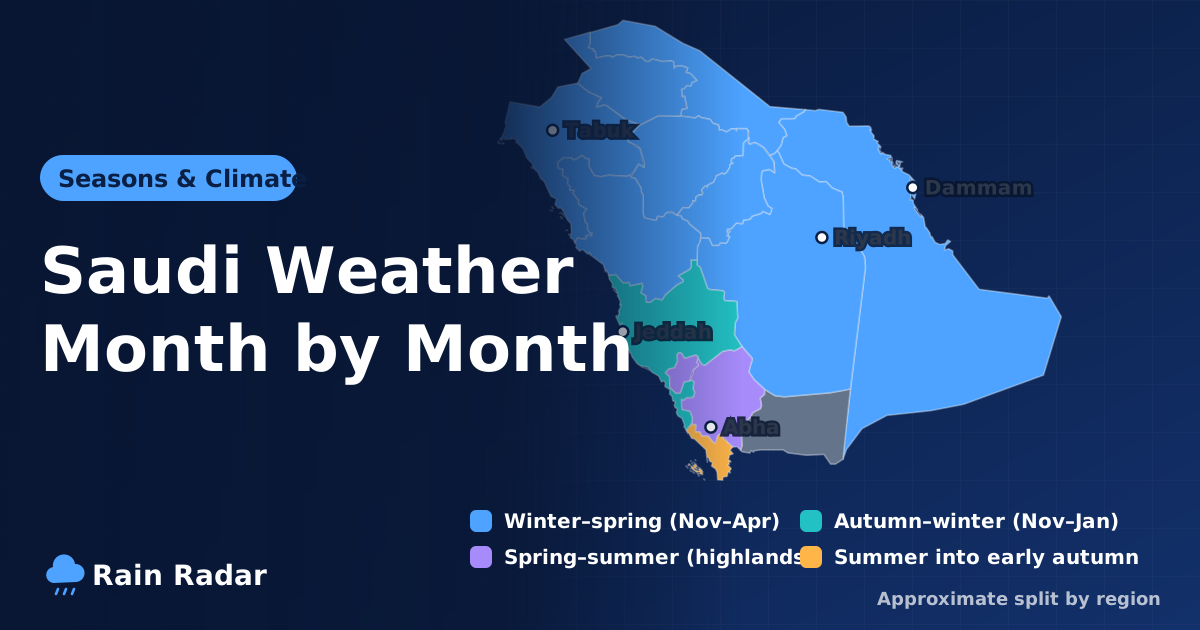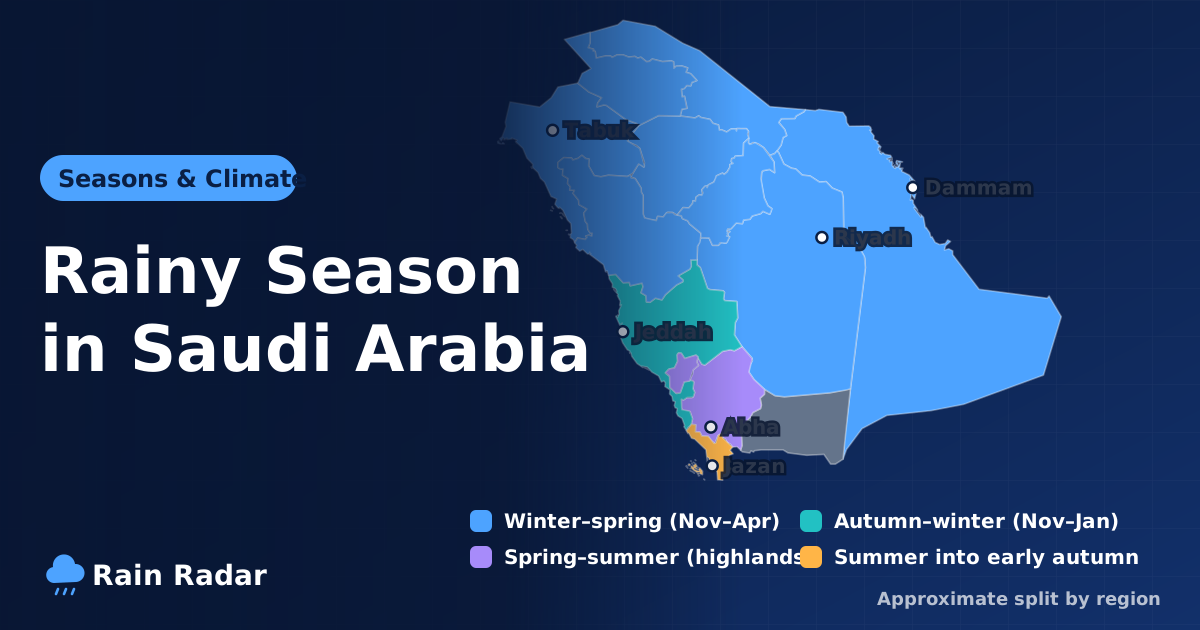
Saudi Arabia does not have one rainy season. In the centre, east and north (Riyadh, Qassim, Dammam, Tabuk), rain usually falls from roughly mid-October to April, with spring thunderstorms often the heaviest. On the west coast (Jeddah, Makkah) rain is concentrated from November to January. The southwestern highlands (Abha, Al-Baha, Jazan's mountains) get most of their rain in spring and summer. These are typical patterns, so for today's rain the live rain radar is always more useful than the calendar.
If you are new to the Kingdom, it can be surprising that a desert country gets rain at all, let alone in different months in different places. This guide explains why, region by region, and shows how to follow rain day to day.
Why doesn't Saudi Arabia have a single rainy season?
The Kingdom is mostly dry, but its rain comes from several different sources. In winter and spring, low-pressure systems moving in from the west and north bring clouds over the centre, north and east. Red Sea troughs sometimes become active at the same time and affect the west coast.
In summer, the southwestern mountains receive moist air from the south. As that air is pushed up the slopes, afternoon thunderstorms build. That is why Riyadh can be bone dry in August while Abha and An-Namas get heavy showers on the same day.
Terrain matters too. Mountains lift moist air and help clouds form, while the vast inland plains get far less. So the better question is always: when is the rainy season where I live or where I am going?
When does it rain in Riyadh and central Saudi Arabia?
In Riyadh, Qassim and the rest of the centre (the region known as Najd), the rainy period traditionally begins with Al-Wasm, the autumn rain season that starts around mid-October in the local calendar, and runs through winter into spring. Spring rain in March and April is often the strongest, arriving as thunderstorms that can bring hail and gusty winds.
Rain in the centre is patchy and irregular. Weeks can pass without a drop, then a single storm can be enough to make the dry channels (called sha'ib) run. Check Riyadh weather for the days ahead.
When is the rainy season in Jeddah, Makkah and Madinah?
Jeddah
Jeddah gets little rain, mostly between November and January. The issue is not the yearly total but the way it falls: short, intense showers can flood streets quickly, as in the well-known Jeddah floods of November 2009. See Jeddah weather now and our Jeddah rain radar guide.
Makkah
Makkah follows a similar timing to Jeddah, with most rain in late autumn and winter and occasional spring thunderstorms. Because the city is ringed by mountains and valleys, a short heavy burst can send water running through low roads.
Madinah
Madinah is further from the sea. Its rain mostly falls in winter and spring, with fewer chances in autumn. Showers are scattered but can be heavy at times and set the surrounding valleys flowing.
Rain in Dammam, the Eastern Province and the north
Dammam and the Eastern Province
Dammam, Al-Khobar, Al-Ahsa and Jubail get most of their rain from roughly November to April, sometimes from thunderstorms drifting in from the centre or off the Gulf. Summers here are almost rainless but extremely humid; morning haze or fog on the coast does not mean rain is coming.
Tabuk, Hail and the Northern Borders
The north (Tabuk, Hail, Arar, Sakaka, Turaif) gets its rain mainly in winter and early spring, roughly November to March. It often comes with cold air, and on rare occasions the higher ground sees light snow or hail. Because evaporation is slower in the cold, the desert greens up in spring, which draws campers and day-trippers.
When does it rain in Taif, Abha, Al-Baha and Jazan?
Taif and the nearby resorts of Al-Hada and Ash-Shafa get spring and summer thunderstorms, mostly in the afternoon, plus scattered rain in autumn and winter. Their altitude makes them wetter than nearby Makkah and Jeddah.
Abha and Asir have two main wet periods: spring (roughly March to May) and summer (roughly July and August), when thunderstorms and fog are frequent around Khamis Mushait, An-Namas and As-Sawdah. Check Abha weather before you go.
Al-Baha behaves much like Asir, with spring and summer rain and frequent fog on wet days. Jazan gets summer rain that can last into early autumn, plus spring showers; the eastern mountains are much wetter than the coastal plain. See Jazan weather.
Rainy season in Saudi Arabia by city (approximate)
The months below are when rain is most likely. They are typical patterns, not fixed dates:
| City or region | Most likely rainy period (approx.) | Note |
|---|---|---|
| Riyadh and Qassim | Mid-October to April | Spring storms often strongest |
| Jeddah and Makkah | November to January | Short, sometimes heavy showers |
| Madinah | December to April | Scattered rain |
| Dammam and Eastern Province | November to April | Dry, humid summers |
| Taif | Spring and summer, scattered winter rain | Afternoon thunderstorms |
| Abha and Al-Baha | March to May, July to August | Frequent fog |
| Jazan | Summer into early autumn, spring showers | Mountains wetter than coast |
| Tabuk and the north | November to March | Cold rain, rare snow |
For the full year at a glance, see Saudi Arabia weather by month.
How to follow the rainy season day by day
Knowing the season helps you plan: a summer trip to Abha means afternoon storms, and a spring desert outing in Najd means dry valleys can flood suddenly. But rain does not follow the calendar. Some years start late or early, and some are much drier than others. So:
- Open the live rain radar and press play to watch the last 2 hours of observed rain in roughly 10-minute frames (RainViewer data). For the days ahead, switch to the 7-day forecast maps, based on NOAA's GFS model.
- Pick your city from all Saudi cities to see the hourly and 7-day forecast (Open-Meteo data).
- Follow official alerts from the National Center for Meteorology (NCM) and Civil Defense during strong rain events.
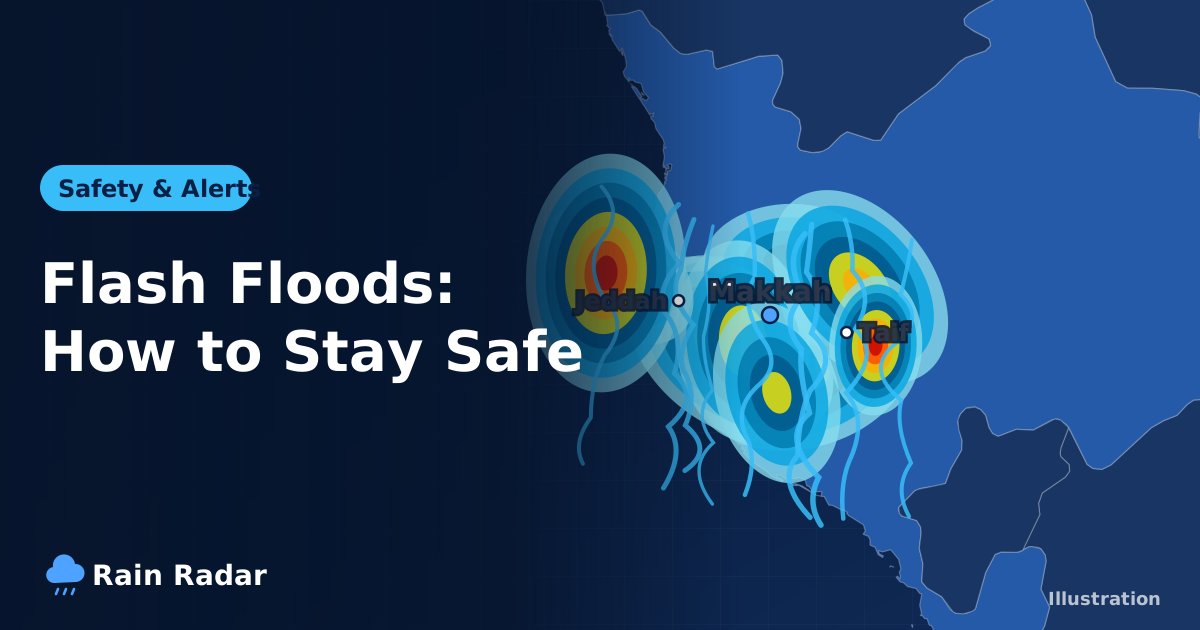
- Stay out of valleys during and after rain; read our flash flood safety guide.
The radar shows rain that has actually been observed, and city forecasts come from numerical weather models. This site does not issue official warnings.
Frequently asked questions
When is the rainy season in Saudi Arabia?
There is no single rainy season. Central, eastern and northern Saudi Arabia get most rain from roughly mid-October to April, the west coast around Jeddah and Makkah mostly from November to January, and the southwestern highlands around Abha, Al-Baha and Jazan mainly in spring and summer.
Which month has the most rain in Riyadh?
Riyadh's rain is irregular, but spring thunderstorms in March and April often bring the heaviest falls. Rain is also possible from the autumn Al-Wasm season through the winter months.
When does it rain in Jeddah?
Jeddah gets little rain overall, and most of it falls between November and January. It often arrives as short, heavy showers that can flood low streets quickly.
Which part of Saudi Arabia gets the most rain?
The southwestern highlands, including Asir, Al-Baha and the Jazan mountains, are generally the wettest part of the country because the mountains help thunderstorms form, especially in spring and summer afternoons.
How can I see if it is raining now in Saudi Arabia?
Open a live rain radar to see observed rainfall over the last 2 hours and which way it is moving, and check your city's hourly and 7-day forecast. For official warnings, follow the National Center for Meteorology and Civil Defense.
Sources: the National Center for Meteorology (NCM) for official alerts; RainViewer radar and Open-Meteo forecasts for the data shown on this site.