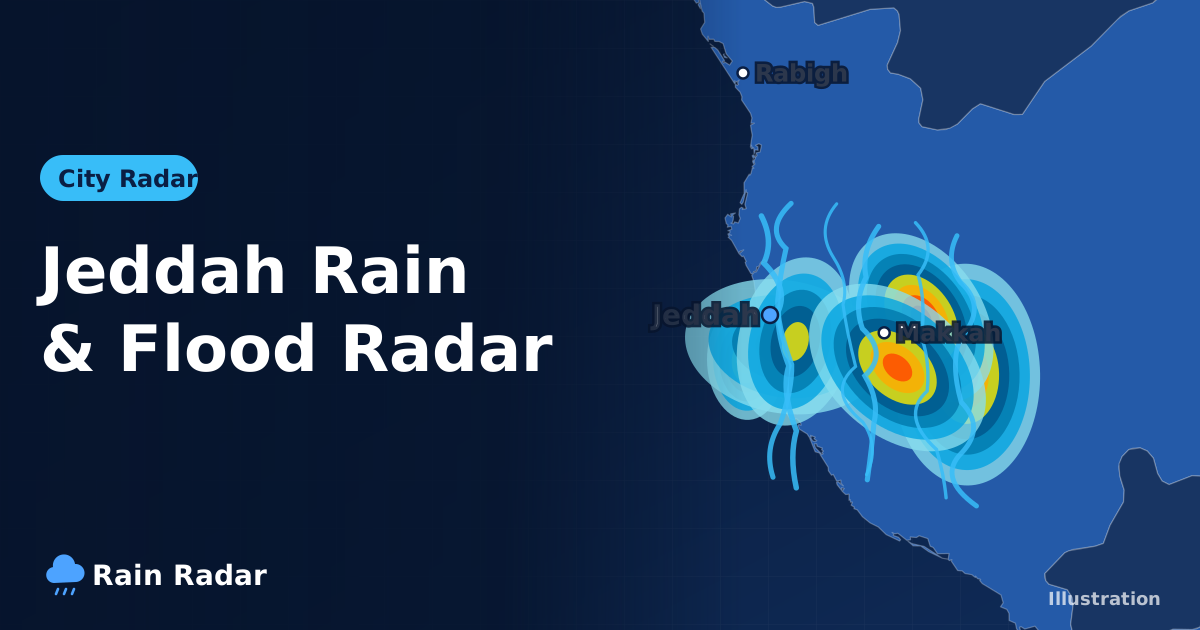
The Jeddah rain radar shows the rain observed over Jeddah and its surroundings in the last two hours, in frames about 10 minutes apart, so you can tell whether it is raining now and from which direction the showers are coming. Jeddah's rain falls mostly between roughly November and January and is light in total, but a single short downpour can be enough to flood streets and set valleys running, because the city sits on a flat coastal plain.
Few cities watch the radar as closely as Jeddah does whenever rain is forecast, and for good reason. This guide explains how to follow the rain radar for Jeddah, when rain is most likely, why some short storms turn into floods, and how to protect yourself and your family.
How do you check the Jeddah rain radar right now?
Open the live rain radar on our home page, zoom in on Jeddah on the Red Sea coast, and then:
- Press play to see rain over the last two hours; each frame is about 10 minutes.
- Watch the hills and high ground east of Jeddah, which is usually where thunderstorms build on unsettled days.
- Estimate direction and speed by comparing a cell's position between frames.
- Open Jeddah weather for the current temperature and humidity, hourly and 7-day forecasts, UV index, and air quality and dust.
On an unsettled day, do not look only at the city itself. A yellow or orange cell over the eastern hills can send water down the valleys towards the eastern districts before any rain reaches the Corniche, or it may weaken and fade before it gets to the coast. Playing the loop several times shows whether a cell is strengthening or dying out.
Note: the radar does not show clouds, only the rain falling from them. If you can see thick cloud but nothing appears on the radar, it is most likely not raining at that moment.
When is the rainy season in Jeddah?
Jeddah is hot and humid for most of the year, and its rainfall is low and irregular. As a rough guide:
| Period (approximate) | What to expect |
|---|---|
| Late October and November | The chance of rain events in western Saudi Arabia starts to rise |
| December and January | Among the likeliest months for rain in Jeddah, often as short thunderstorms |
| February to April | Occasional events, less frequent |
| Summer (about May to September) | Hot and humid; rain over the city is rare, though storms may build over the eastern hills |
Residents often notice that rain arrives as one strong event over a day or two, followed by weeks of clear skies. That is why the yearly total says little about the risk. What matters is how hard it rains during the few hours it does, and that is exactly what the radar colours reveal.
Years vary widely: some bring very little rain, others more than one major event. Follow the radar and hourly forecast rather than relying on the month alone, and see the rainy season in Saudi Arabia for the wider picture.
Why does Jeddah flood after a short storm?
Many people are surprised that a brief shower can flood roads in Jeddah. The cause is not only the amount of rain but the shape of the land.
A coastal plain fed by valleys
Jeddah lies on a flat strip between the Red Sea to the west and a line of hills and mountains to the east. When heavy rain falls on that high ground, water runs down the valleys towards the city and the sea, reaching eastern districts and low roads even if the rain over them was light.
Surfaces that do not absorb water
Paved roads, buildings and hard ground soak up little water, so most of it flows over the surface and collects in low spots and underpasses.
Intense rain in a short time
Thunderstorms in western Saudi Arabia can be very intense for a short period. Orange or red on the Jeddah radar deserves far more attention than a wide blue area of light rain.
Where does water usually collect?
- Tunnels, underpasses and low junctions.
- Districts and roads close to valley channels coming from the east.
- Basement car parks and low empty plots.
- Roads with ongoing construction or excavation.
The 2009 Jeddah floods: the lesson that stuck
In November 2009 Jeddah was hit by deadly flash floods that caused heavy human and material losses. The event became a widely cited example of how dangerous sudden floods can be in a coastal city surrounded by valleys, and it led to greater investment in drainage and flood protection and more attention to weather alerts.
The key lesson for residents and visitors is simple: never underestimate a rain event in Jeddah. Rain that looks ordinary in your district may be part of a larger system over the hills, and the radar is the tool that shows you that bigger picture. For the nationwide view, read our guide to flash floods in Saudi Arabia.
Humidity and dust in Jeddah
High humidity from the Red Sea is the defining feature of Jeddah's weather, especially in summer. It makes the heat feel much stronger than the actual reading and sometimes brings light haze or mist early in the morning.
On hot, humid days the body loses a lot of fluid through sweat, so drink water regularly, limit outdoor activity around midday, and save Corniche walks for early morning or after sunset. Check the UV index on the city page before going out.
Jeddah is also hit by dust from time to time, which lowers visibility and air quality. The city page shows a dust and air quality card, and our guide to dust storms in Saudi Arabia covers the topic in depth.
How to stay safe during rain in Jeddah
- Check the Jeddah radar and forecast before going out on unsettled days.
- Avoid tunnels, underpasses and low roads during and after heavy rain.
- Never drive into flooded streets or valley channels; depth and current are very hard to judge.
- Keep away from electricity poles and cables while it is raining.
- Travelling to Makkah or Rabigh? Check the weather and road conditions at your destination before you leave.
- Follow Civil Defense instructions as soon as they are issued, even if the rain looks light where you are.
Before the season starts, clear roof and balcony drains, avoid parking in low spots or under trees and large signs on unsettled days, and keep a charged phone and emergency numbers to hand.
Jeddah rain radar and official warnings
Our site does not issue official warnings. The radar shows observed rain and the Jeddah page shows model forecasts. Alerts and early warnings come from the National Center for Meteorology (NCM), and safety instructions come from Civil Defense. To understand the alert levels and how to respond, read NCM weather alerts explained.
Frequently asked questions
When is the rainy season in Jeddah?
Most of Jeddah's rain falls roughly between November and January, and some events start in late October. Total rainfall is low and irregular, but it can arrive as a heavy downpour in a short time.
Why does Jeddah flood so quickly when it rains?
Jeddah lies on a flat coastal plain that receives runoff from valleys draining the hills to the east, and its paved surfaces absorb little water. Even a short, heavy storm can therefore flood underpasses and low streets.
Does the Jeddah radar show all the clouds?
No. A rain radar detects falling raindrops, not clouds, so clouds that are not raining do not appear. Satellite images are used to see clouds in general.
Why does Jeddah feel hotter than the thermometer says?
Because of the high humidity from the Red Sea, which makes it harder for the body to cool down by sweating. In summer the feels-like temperature is often well above the actual reading.
Does this site issue flood warnings for Jeddah?
No. The site shows observed radar rain and forecasts only. Official warnings come from the National Center for Meteorology (NCM) and safety instructions from Civil Defense.
Sources: the National Center for Meteorology (NCM) for official alerts; RainViewer radar and Open-Meteo forecasts for the data shown on this site.