Saudi Arabia's early-warning system is the set of official alerts that the National Center for Meteorology (NCM) issues for high-impact weather such as heavy rain, flash floods and dust, while Civil Defense guides the public and sends warnings to phones when needed. An alert is different from a daily forecast and from what you see on the live rain radar: the alert is what your safety decisions should be based on.
This guide explains how to read an NCM weather alert, how it differs from forecasts and radar, and what to do when one is issued for your area.
What is an early warning, and why does it matter?
The idea is simple: know about danger early enough to act. Instead of being surprised by a flood or a dust storm on the road, you receive an alert that names the expected hazard, the areas affected and the time window.
In the Kingdom, the NCM monitors the weather and issues alerts, and Civil Defense turns them into practical instructions for the public, including warning messages sent to phones in affected areas during significant events.
Early warning matters in a country where sudden floods in valleys and dust storms inland are recurring hazards, as the Jeddah floods of November 2009 reminded everyone. It also covers more than rain: strong winds raising dust, low visibility from fog or dust, and high waves in the Red Sea and the Arabian Gulf. Drivers, fishermen and boat users, desert campers and families living near wadis all benefit.
- Shows the rain falling right now
- Covers the last two hours
- Helps you see where clouds are moving
- An estimate of what may happen next
- Hour by hour and 7 days ahead
- A probability, not a certainty
- Issued by the National Center for Meteorology (NCM)
- Sets the risk level and area
- The reference for your decisions
How to read NCM weather alerts and their levels
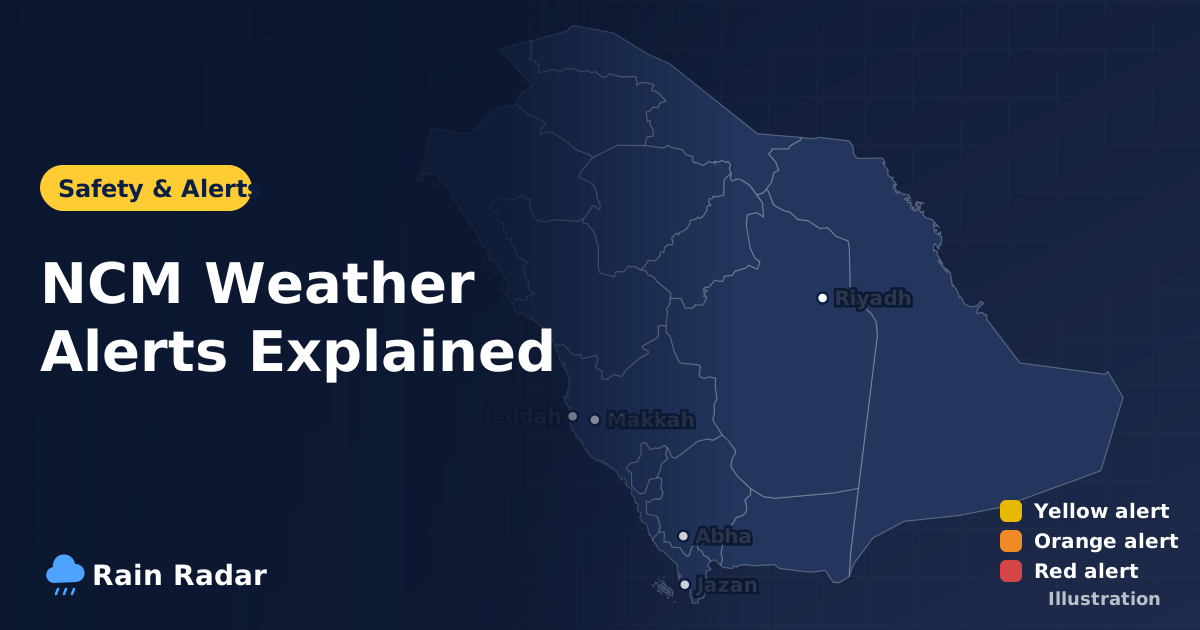
Saudi weather alerts are usually shown in rising colour levels, such as yellow, then orange, then red. The higher the level, the more severe or widespread the expected event and the more caution it calls for. We do not give official definitions for each level here, because the reference for those is the NCM itself.
More important than the colour is the text of the alert. When you read one, look for:
- The hazard: thunderstorms, flash floods, strong dusty winds, very low visibility, high waves, or other events.
- The areas covered: an alert may cover parts of a region, not the whole region.
- The time window: when the alert starts and when it ends.
- Accompanying phenomena: hail, downburst winds or reduced visibility.
- Guidance: what the authorities advise you to do.
You can see official alerts directly on the National Center for Meteorology website or through its official apps and accounts.
Alert, forecast or radar: what is the difference?
People often mix up three different things. Knowing which is which helps you use each one properly.
| Source | What it tells you | Time frame | Use it for |
|---|---|---|---|
| NCM alert / early warning | An expected high-impact event and its severity | Coming hours or days | Safety and travel decisions |
| Model forecast (city pages) | Expected temperature, rain chance and wind | Hourly, up to 7 days | Daily and weekly planning |
| Live radar | Rain actually observed and how it is moving | Last 2 hours | Seeing where it is raining now and where it is heading |
Rain Radar Saudi Arabia shows observed radar rainfall (RainViewer), 7-day forecast maps (NOAA GFS) and city forecasts (Open-Meteo). It does not issue any official alerts or warnings. The official sources are the NCM and Civil Defense.
Do not confuse radar colours with alert colours
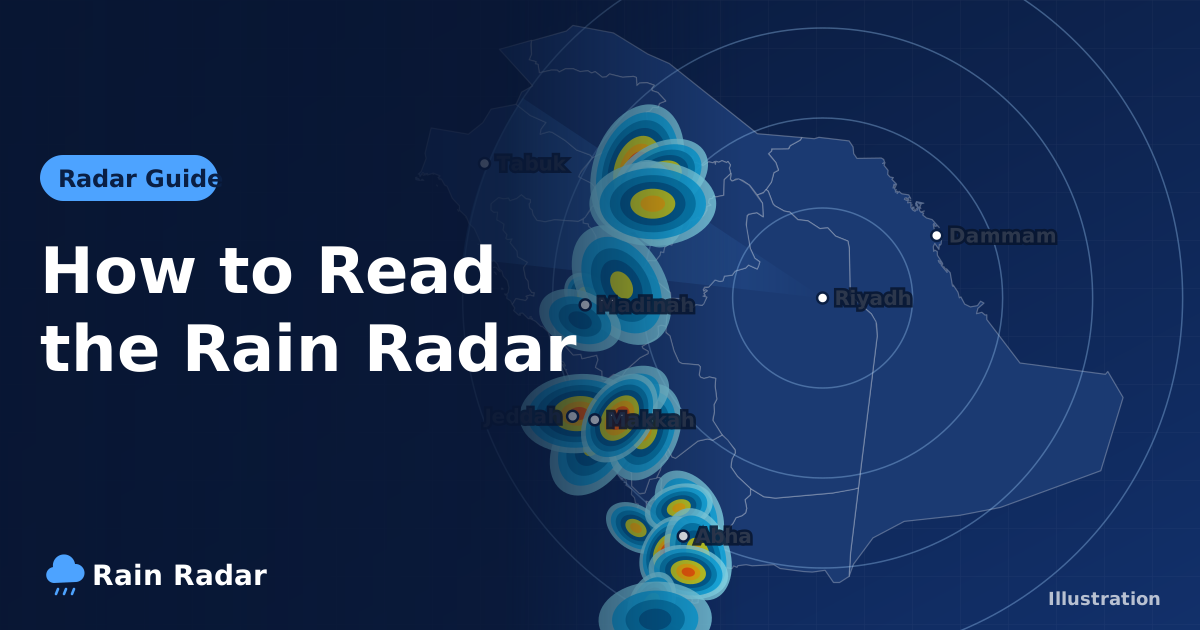
Radar colours on our map show rain intensity at a given spot and moment: light cyan for light rain, blue for moderate, yellow and orange for heavy, and red or pink for very heavy rain usually linked to thunderstorms. Alert colours show the expected level of risk for a whole area. They are two completely separate systems.
Why the radar and the alert can disagree
An alert may be issued for your city while the radar shows no rain overhead, and that does not mean the alert is wrong. The alert is about the hours ahead, while the radar only shows what fell in the last 2 hours. The reverse also happens: a short, intense shower may pass without a specific alert because it covers a small area.
Radar also has natural limits. Mountains can block part of the signal, and ground clutter or dust sometimes shows up as false echoes. Use radar to follow what is happening now, and the official alert to judge the risk.
Following a rain event step by step
When people talk about "the coming rain event", the best approach is to follow it in stages:
- Days before: follow NCM bulletins and check the 7-day forecast for your city in all Saudi cities.
- Hours before: check the hourly forecast on your city page, such as Jeddah weather or Jazan weather, to see which hours are most likely to be wet.
- As clouds approach: open the live radar, which shows the last 2 hours in roughly 10-minute frames, and press play to see the direction and speed of rain cells.
- During and after the rain: follow Civil Defense instructions, and remember that wadis can keep flowing long after the rain stops.
To understand the map colours and radar limits in detail, read our guide to the Saudi rain radar.
What to do when an early warning is issued
An alert is only useful if it leads to action. General steps:
Rain and flood alerts
- Never cross flowing wadis or flood channels, by car or on foot, however shallow the water looks.
- Avoid tunnels and low streets where water collects.
- Postpone desert trips and never camp in valley beds.
- Stay away from power poles and cables during thunderstorms.
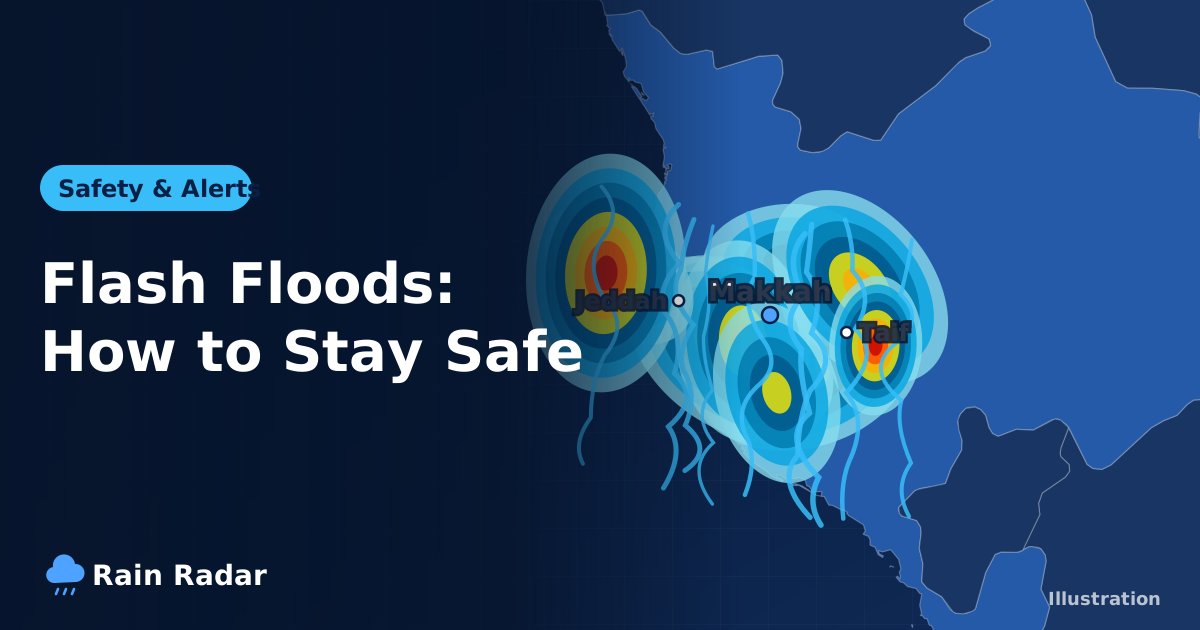
For more, read our flash flood safety guide. In an emergency, call Civil Defense on 998.
Dust and wind alerts
- Slow down when driving, use low-beam headlights, and pull off to a safe place if visibility is lost.
- Close windows and stay indoors as much as possible, especially if you have asthma or allergies.
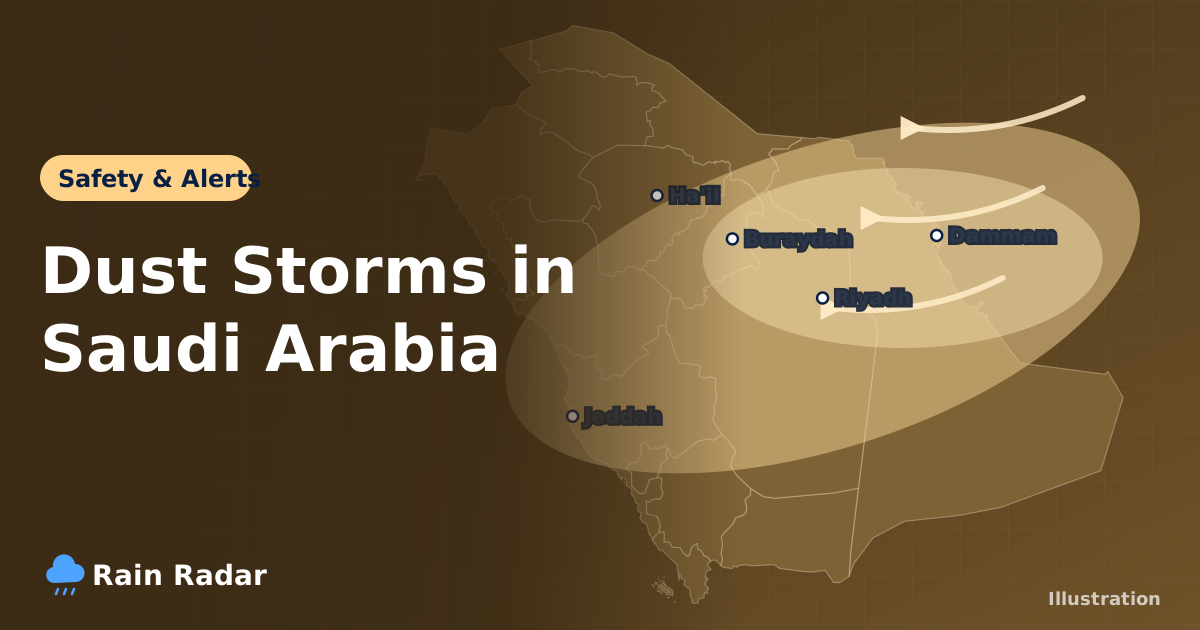
- Check the air quality and dust card on your city page, and see our guide to dust storms in Saudi Arabia.
Common mistakes with weather alerts
Alerts are clear, yet some mistakes keep happening, and they can be costly:
- Ignoring an alert because the sky overhead is clear, even though floodwater can come from rain far up the valley.
- Relying on unverified videos and forwarded messages instead of official accounts.
- Treating the radar as a substitute for an alert; it shows what is happening now, but does not assess risk or capture every detail in the mountains.
- Going out to watch floods and getting close to the water out of curiosity.
Make the NCM and Civil Defense your first source for alerts, and use the rain radar and city pages as tools to understand what is happening around you. That way you combine the official decision with a live picture of the weather.
Frequently asked questions
Who issues weather warnings in Saudi Arabia?
The National Center for Meteorology (NCM) monitors the weather and issues official weather alerts. Civil Defense turns these into practical guidance and can send early-warning messages to phones in affected areas.
What do the yellow, orange and red alert colours mean?
NCM alerts are usually shown in rising colour levels such as yellow, orange and red; the higher the level, the more severe or widespread the expected event. For the exact definition of each level, refer to the NCM itself.
Why is there an alert for my city when the radar shows no rain?
An alert covers conditions expected over the coming hours, while radar shows only rain observed in the last 2 hours. An alert with a clear radar does not mean the alert is wrong.
Is a rain radar the same as an official warning?
No. Radar shows where rain is falling now and how heavy it is, but it does not assess risk. Base safety decisions on official NCM alerts and Civil Defense instructions.
Where can I see official NCM alerts?
On the National Center for Meteorology website at ncm.gov.sa and through its official apps and social media accounts. Civil Defense early-warning messages arrive on phones in affected areas.
Sources: the National Center for Meteorology (NCM) for official alerts; RainViewer radar and Open-Meteo forecasts for the data shown on this site.