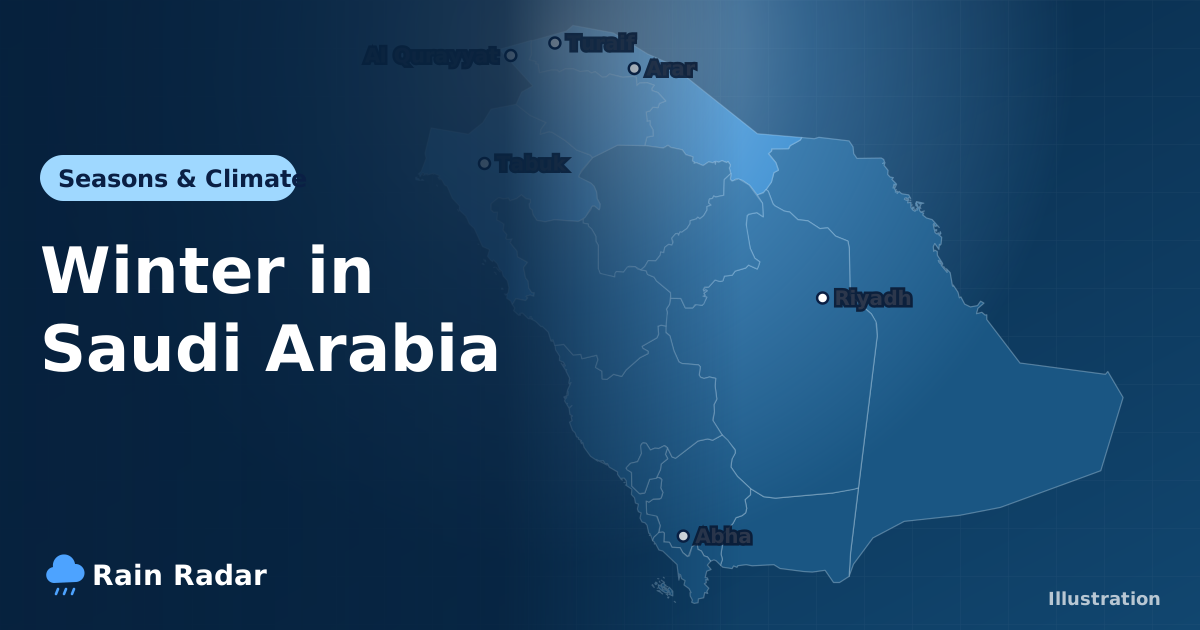
Al-Murabba'aniyah (المربعانية, also spelled Murabbaniyah) is the first period of hard cold in the traditional Najdi calendar of central Arabia. It begins in early December (often given as around 7 December) and lasts about 40 days, to mid-January. It is followed by Ash-Shabt (about 26 days) and then Al-Aqarib (about 39 days). The dates are inherited and approximate: they give you the shape of winter, while official forecasts and the live rain radar tell you what the weather is actually doing.
If you have heard colleagues in Riyadh say "the Murabba'aniyah has started" and wondered what they meant, this guide explains the term, the dates and what to expect.
What is Murabba'aniyah, and why is it called that?
Al-Murabba'aniyah is a popular name for a stretch of winter that the people of Najd and the wider Arabian Peninsula have recognised for centuries, and used to organise grazing, farming and travel. The most common explanation of the name links it to the number forty (arba'in), because it traditionally lasts about forty days.
It belongs to a wider system based on the rising of stars, which split the year into successive seasons, each with its own character of heat, cold or rain. Murabba'aniyah is said to contain three star periods, Al-Iklil, Al-Qalb and Ash-Shawlah, each about thirteen days long.
Treat it as a traditional, approximate calendar rather than an official scientific one. It distils generations of weather watching, so cold spells can arrive earlier or later than the calendar says.
When does Murabba'aniyah start, and how long does it last?
The two questions people ask most are "which month does it start?" and "how many days is it?" The usual answer: it starts in the first week of December, often on about 7 December, and ends around mid-January, giving roughly 40 days.
Some folk calendars put the first day a day or two earlier or later, so there is no need to fix on an exact date. What matters is that this period sits at the heart of winter, when nights are long and cold, particularly inland and in the north.
The three traditional cold periods (approximate)
| Period | Approximate start | Approximate length | General character |
|---|---|---|---|
| Al-Murabba'aniyah | Early December (around 7 Dec) | About 40 days | Hard cold begins, long nights |
| Ash-Shabt | Around mid-January | About 26 days | Often the coldest stretch |
| Al-Aqarib | Around mid-February | About 39 days | Cold gradually breaks; wind and changeable weather |
All dates and lengths are traditional approximations, not official dates.
What comes after Murabba'aniyah: Shabt and Aqarib
Winter does not end when Murabba'aniyah does. It moves into a stage many consider harsher, Ash-Shabt, and then Al-Aqarib signals the turn towards spring.
Ash-Shabt (الشبط)
Shabt follows straight after Murabba'aniyah and lasts about 26 days, from roughly mid-January to around 10 February. It is known as the peak of the cold: night temperatures drop noticeably, and frost can form in the north and on high ground.
Al-Aqarib (العقارب)
Al-Aqarib, "the scorpions", runs for about 39 days from roughly mid-February to around 20 March and is traditionally split into three "scorpions". The cold starts to ease, but the weather becomes changeable: strong winds and dust are common, and short cold snaps can still take people by surprise.
What weather to expect during Murabba'aniyah
Cold is the dominant feature, but how cold depends a great deal on where you are:
- Central Saudi Arabia: cold nights and early mornings in Riyadh and Qassim, with mild, sunny days much of the time.
- The north: the coldest part of the country. In Turaif, Al-Qurayyat, Arar and Tabuk, temperatures can approach or fall below 0 °C on some nights.
- Southwestern highlands: cold nights in Abha, An-Namas and Al-Baha, with fog on some days.
- The coasts: relatively mild in Jeddah and Dammam, where the sea keeps temperatures gentler than inland.
- Rain: scattered showers or passing rain events are possible in the centre, north and east.
To follow it in practice, open any city from all Saudi cities to see the current temperature, hourly forecast and 7-day outlook. That is far more precise than relying on the calendar alone.
Is Murabba'aniyah accurate? Tradition versus modern forecasting
Murabba'aniyah captures the general trend well: December and January are the heart of the cold season in Najd. What it cannot do is tell you when a particular cold wave will arrive or whether it will rain tomorrow.
Many people notice that some years Murabba'aniyah is milder than usual, and the real cold arrives in Shabt or even Aqarib. That is normal, because cold in Saudi Arabia comes from cold air masses flowing down from the north, and those follow large-scale pressure patterns, not a fixed calendar.
Modern forecasts rely on weather stations, satellites and numerical models. This site uses model forecasts (Open-Meteo for city pages, NOAA GFS for the 7-day maps) and radar data (RainViewer) for observed rain. The official reference for warnings is the National Center for Meteorology.
In other words: use Murabba'aniyah to understand and prepare for the season, and use forecasts to plan your day. For the bigger picture, read winter in Saudi Arabia.
How to prepare for Murabba'aniyah and the Shabt cold
- Watch night-time lows, not just daytime highs; the gap can be large in the desert and inland.
- Heat safely: never use charcoal, wood or gas heaters in a closed room without ventilation, because of the risk of carbon monoxide poisoning.
- Look after older people and children, who feel the cold most, with enough warm clothing.
- Plan desert trips after checking the forecast, take enough blankets, and check for rain before you leave.
- Take care with morning fog when driving, especially on highways and mountain roads.
If rain arrives while you are out in the desert, open the rain radar to see the last 2 hours of rain movement, and keep well away from valleys and flood channels.
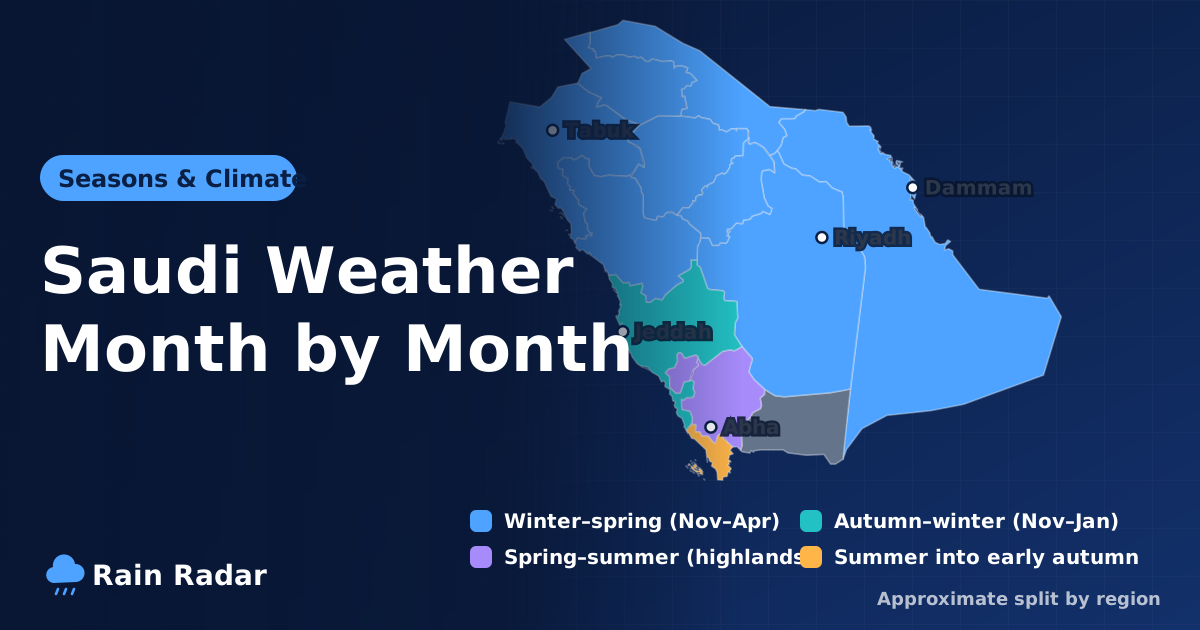
Murabba'aniyah follows Al-Wasm, the autumn rain season, and after Aqarib comes spring with its mild days and thunderstorms. For a full-year overview, see Saudi Arabia weather by month.
Frequently asked questions
When does Murabba'aniyah start?
In the traditional Najdi calendar, Al-Murabba'aniyah starts in early December, usually given as around 7 December, and ends around mid-January. These are inherited folk dates, not official or astronomical ones.
How many days is Murabba'aniyah?
About 40 days, which is where many people say the name comes from (arba'in means forty). Different folk calendars may vary slightly in the exact length.
What comes after Murabba'aniyah?
Ash-Shabt follows for about 26 days, from mid-January to around 10 February, and is often considered the coldest stretch. Then Al-Aqarib lasts about 39 days, from mid-February to around 20 March, as the cold slowly breaks with windy, changeable weather.
Does the National Center for Meteorology use Murabba'aniyah in its forecasts?
No. The NCM relies on observations and modern numerical weather models. Murabba'aniyah is a traditional calendar that is useful as a rough guide to the season, not for daily forecasts.
Does it rain a lot during Murabba'aniyah?
Scattered winter rain is possible in central and northern Saudi Arabia, but the defining feature of Murabba'aniyah is cold, especially at night, rather than heavy rain.
Sources: the National Center for Meteorology (NCM) for official alerts; RainViewer radar and Open-Meteo forecasts for the data shown on this site.