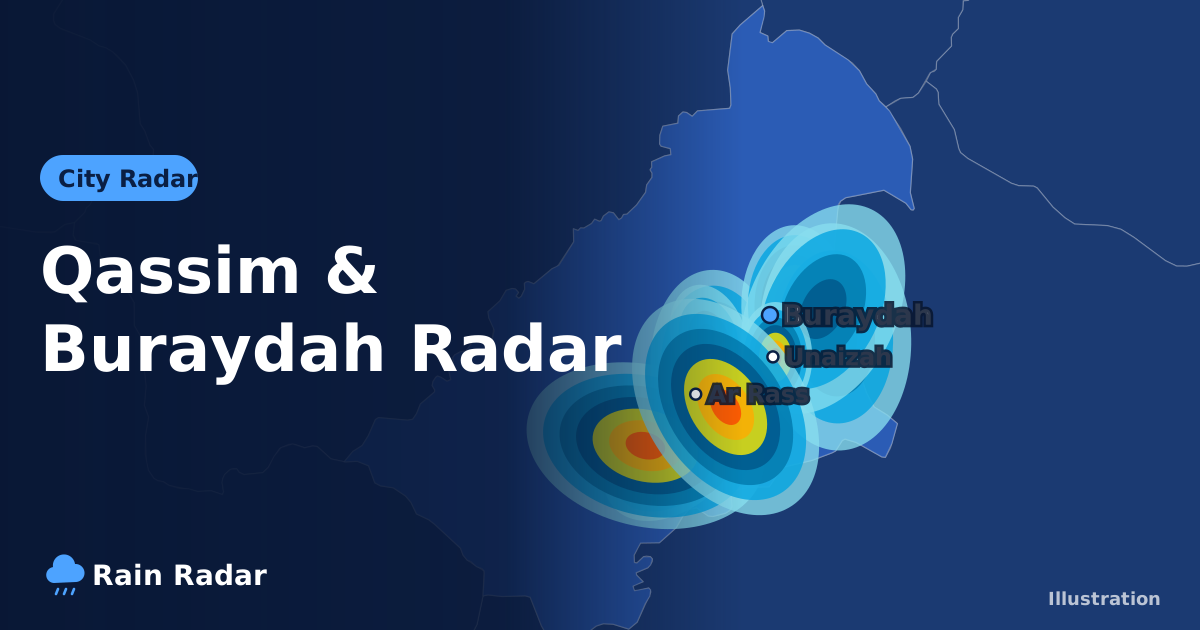
The Qassim rain radar shows the rain observed right now over Buraydah, Unaizah, Ar Rass and the surrounding farmland: open the live radar and press play to see rain clouds move over the last two hours, in frames about 10 minutes apart. Qassim's rain usually falls from late autumn to spring, starting with the Al Wasm season, continuing with winter rain and ending with spring thunderstorms.
For a farming region known for dates, wheat and vegetables, knowing when rain, frost or hail is coming matters more than most. This guide explains how to read the radar over Qassim, what each season brings, and how to stay safe on desert trips.
How do you read the rain radar over Buraydah, Unaizah and Ar Rass?
The radar observes rain that is actually falling; it does not predict it. That makes it the right tool to check whether a rain event has reached Qassim, where the rain is now and where it is heading.
- Open the live rain radar and zoom in on central Saudi Arabia until Buraydah, Unaizah and Ar Rass appear.
- Press play to watch the last two hours in sequence and note the direction of travel. Clouds often move from the west or south-west towards the east, but that is not a fixed rule.
- Read the colours roughly: light sky blue for light rain, blue for moderate, yellow and orange for heavy, and red to pink for very heavy rain, often with thunderstorms.
- Open the page for your city for the hourly forecast and the next 7 days.
Why does the radar show rain that never reaches you?
In the dry air of central Saudi Arabia, some rain evaporates before it hits the ground, so the radar sees it aloft while you feel no drops. Thunderstorm cells can also be small, drenching one district or farm while the next stays dry. Find your exact location on the map and follow the motion between frames.
When does it rain in Qassim?
Qassim sits in the heart of Najd, with a desert climate that is hot and dry in summer and cold in winter. Rain is seasonal and irregular: one year can be wet and the next very dry. Knowing a few hours ahead helps farmers delay irrigation or protect crops and equipment.
| Period (approximate) | What to expect in Qassim |
|---|---|
| Al Wasm (from about mid-October, for roughly 52 days) | The first chances of rain after summer; this rain is valued for helping desert plants grow |
| Winter | Clearly cold, especially at night, with rain from passing low-pressure systems at times |
| Spring | Thunderstorms that can bring hail, strong winds and dust |
| Summer | Very hot and dry; rain is rare |
Al Wasm rain in Qassim
In the traditional Najdi calendar, Al Wasm starts around mid-October and lasts about 52 days. Its rain is cherished in Qassim as a sign of a green spring ahead. These dates are inherited folk markers, not a precise scientific calendar. Read more in our guide to the Al Wasm season.
Spring thunderstorms
In spring, strong thunderstorms sometimes build over Qassim, bringing hail and downdraft winds that raise dust before the rain arrives. On the radar they appear as small yellow or red cells moving quickly, so check them often.
Buraydah, Unaizah and Ar Rass weather
Qassim's main cities are close together and their weather is broadly similar, but a thunderstorm can hit one town and miss another on the same day.
- Buraydah: the regional capital. See current temperature, hourly forecast and air quality on Buraydah weather.
- Unaizah: south of Buraydah. Unaizah weather shows the hourly and 7-day forecasts.
- Ar Rass: to the south-west. Follow Ar Rass weather for the UV index and sunrise and sunset times.
For anywhere else in the Kingdom, browse all Saudi cities.
Winter cold in Qassim and the Murabbaniyah
Qassim winters are cold, especially at night and early in the morning. On some nights during cold waves, temperatures can approach or fall below zero and frost can form on farms and open ground, which matters to farmers, livestock owners and anyone camping in the desert.
In popular memory, the coldest stretch is linked to the Murabbaniyah, a traditional period that starts around early December and lasts about 40 days, followed by Al Shabt and Al Aqarib. These dates are also approximate folk divisions. Read more about the Murabbaniyah winter season.
Tip: on cold winter nights, check the hourly forecast on your city page to see when the temperature bottoms out, which is usually around dawn.
Dust, flash floods and desert trips in Qassim
Dust is part of Qassim's weather, especially in spring and early summer when winds pick up. The air quality and dust card on each city page helps if you have asthma or allergies, or if you are driving long desert roads.
After heavy rain, channels (shuaib) and valleys can run and water collects in low areas. Qassim is also crossed by Wadi Al Rummah, one of the longest valleys in the Arabian Peninsula, which flows in years when heavy rain falls along its course.
- Never drive across a running wadi or channel, however little water there seems to be.
- Do not camp in valley beds or channels during the rainy season.
- Avoid tunnels and low roads after heavy rain.
- In dust, slow down and leave a safe following distance.
Whether you are in town, on a farm or on a desert outing (kashta), check the radar before you leave and during the trip, zoom out to see what is approaching from the west and south, and pitch camp well away from any channel. In summer, temperatures can pass 40°C on many days, so check the UV index too.
Official weather alerts for Qassim
Our site does not issue official warnings. The radar shows observed rain and the city pages show model forecasts. Alerts and early warnings for the Qassim region come from the National Center for Meteorology (NCM), and Civil Defense issues safety instructions.
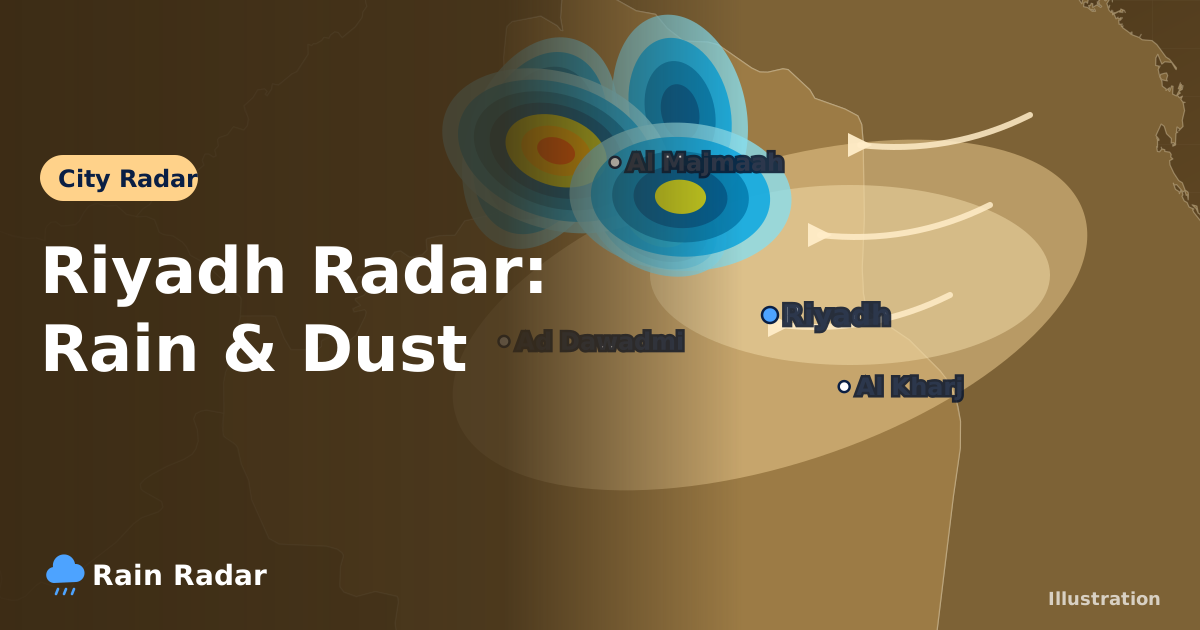
When a thunderstorm alert is issued for Qassim, open the radar to watch the cells approach and follow official instructions until the event is over. Driving to the capital? Read our Riyadh rain radar guide to check conditions along the way.
Frequently asked questions
How can I follow rain in Qassim right now?
Open the live radar on our home page, zoom in on the Qassim region and press play to see rain over the last two hours in frames about 10 minutes apart. City pages for Buraydah, Unaizah and Ar Rass add hourly and 7-day forecasts.
When is the rainy season in Qassim?
Qassim's rain usually falls from late autumn to spring. The chances begin around the traditional Al Wasm season from roughly mid-October, continue through winter, and end with spring thunderstorms. Totals vary greatly from year to year.
Does it freeze in Qassim in winter?
On some cold winter nights temperatures can approach or dip below zero in open areas and farmland, especially during cold waves, and frost can form. Check the hourly forecast on the city page for the overnight low.
Why does the radar show rain in Buraydah when none is falling?
In dry air over central Saudi Arabia, rain can evaporate before reaching the ground, so the radar detects it aloft while you feel nothing. The rain may also be falling just a few kilometres from you.
Does this site issue official alerts for Qassim?
No. The site shows observed radar rain and model forecasts only. Official alerts come from the National Center for Meteorology (NCM) and safety instructions from Civil Defense.
Sources: the National Center for Meteorology (NCM) for official alerts; RainViewer radar and Open-Meteo forecasts for the data shown on this site.